Traditional wellness · educational
Acupressure for Nausea
PC6 is the point most associated with nausea in traditional practice — and the one you can press on a plane, in a car, or at your desk without anyone noticing.
Start with these
- PC6 — inner forearm, above the wrist · press in & up · 30–60s each arm
How to press
Tool — your thumb pad or index-finger knuckle. No gadgets needed.
Angle — press straight in, perpendicular to the skin.
Pressure — firm but comfortable: a dull ache, never sharp pain.
Time — 30–60 seconds per point. Breathe slow, press on the exhale.
The points, one by one
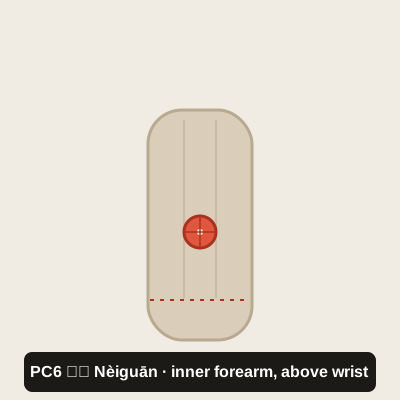
PC6 · Nèiguān
内关 · inner forearm, above wrist
Why people try it
A staple of travel and calming routines in traditional practice.
How to use
Thumb presses in & up, 30–60s.
When to try
Before or during travel, or when your stomach feels uneasy.
How to tell you've got it
A sore, faintly tingly feeling between the two tendons, sometimes reaching the palm.
Common mistake
Landing on the wrist crease itself. Measure three finger-widths up from the crease first, then press.
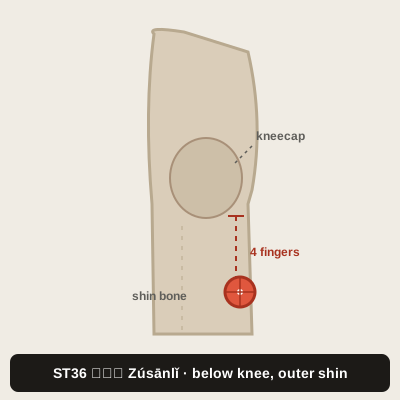
ST36 · Zúsānlǐ
足三里 · below knee, outer shin
Why people try it
A classic point used in traditional routines for everyday vitality.
How to use
Thumb straight in, 60s; nice after meals.
When to try
After meals or when you feel sluggish.
How to tell you've got it
A deep ache that can run down toward the foot.
Common mistake
Pressing straight onto the shin bone — that is painful, not useful. Slide one thumb-width outward, onto the muscle.
The full routine
1PC6
inner forearm · press in & up · 30–60s each arm
→
2ST36
below the knee · thumb straight in · 60s each leg
Press PC6 a few minutes before you travel, and again if your stomach feels uneasy. A travel-band or firm ring worn at the same spot is a common companion. ST36 is the one to add if the uneasy feeling comes after eating.
Common questions
Which acupressure point is used for nausea?
PC6 (Nèiguān), on the inner forearm about three finger-widths above the wrist crease, between the two tendons. It is the point most commonly associated with nausea and travel comfort in traditional practice. ST36, below the knee, is often used after a heavy meal.
Where exactly is PC6?
Measure three finger-widths up from the wrist crease on the inner forearm, then feel between the two tendons. You are looking for a sore, faintly tingly feeling that sometimes reaches the palm.
Is it safe to use during pregnancy?
PC6 itself is not on the traditional avoid-in-pregnancy list — but several other points are (LI4, SP6, GB21). If you are or may be pregnant, check with a qualified practitioner before using acupressure, and see a clinician for persistent nausea or vomiting.
Want all 15 points in one printable guide?
This page covers what you need for today. The Starter Kit puts the full set of 15 points together
with 6 ready-to-use routines — bedtime, travel, daily reset, morning, desk and monthly comfort — plus
9 hand-demo clips so you can see the press-and-hold motion, not just read about it.
- ✓ 15 points, each with a clear diagram
- ✓ 6 guided routines
- ✓ 9 hand-demo clips — included with your kit
- ✓ Yours forever + every future update
Get the Starter Kit — $12
See all 15 points first — free
Educational use only — not medical advice. Acupressure is a traditional practice, not a medical treatment.
This page describes how the points are traditionally used; results vary, and nothing here diagnoses, treats, or
cures any condition. Points marked as avoided in pregnancy (LI4, SP6, GB21) should be skipped if you are or may be
pregnant — check with a qualified practitioner first. Don't press on injured, inflamed, or broken skin.
For persistent, severe, or worsening symptoms, see a clinician.
← Back to PRESS HERE · All 15 points ·
Privacy · Terms