Traditional wellness · educational
Acupressure for Headaches
When head or face tension builds, these are the points people reach for in traditional practice. Start with the first two — add the others if you have another minute.
Start with these
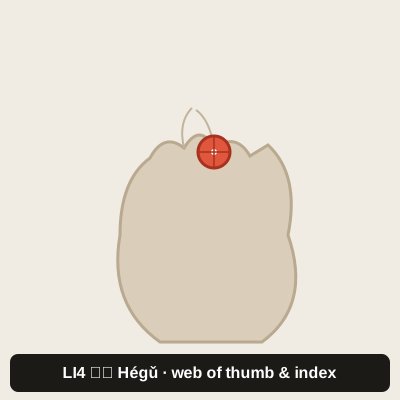
- LI4 — web of thumb & index · 30–60s each hand
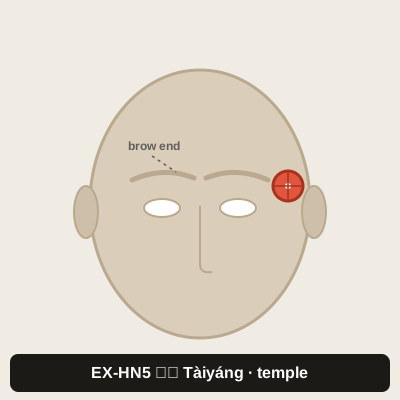
- Taiyang — temple · small circles · 30s each side
How to press
Tool — your thumb pad or index-finger knuckle. No gadgets needed.
Angle — press straight in, perpendicular to the skin.
Pressure — firm but comfortable: a dull ache, never sharp pain.
Time — 30–60 seconds per point. Breathe slow, press on the exhale.
The points, one by one
LI4 · Hégu
合谷 · web of thumb & index
Why people try it
A go-to point in traditional practice for everyday head, face, and hand tension.
How to use
Thumb of other hand, firm circle, 30–60s.
When to try
At the first sign of everyday head or face tension.
How to tell you've got it
A dull ache that spreads across the hand — you may feel it travel toward the wrist.
Common mistake
Pressing the soft skin at the very edge of the web. Move slightly toward the index-finger bone until you meet firm muscle.
⚠️ Traditionally avoided in pregnancy
EX-HN5 · Tàiyáng
太阳 · temple
Why people try it
Used for temple-area tension.
How to use
Index, small circles, 30s each side.
When to try
When your temples ache.
How to tell you've got it
A mild ache in the shallow hollow beside the brow.
Common mistake
Pressing on the bone at the edge of the eye socket. Move about a finger-width back, into the soft dip.
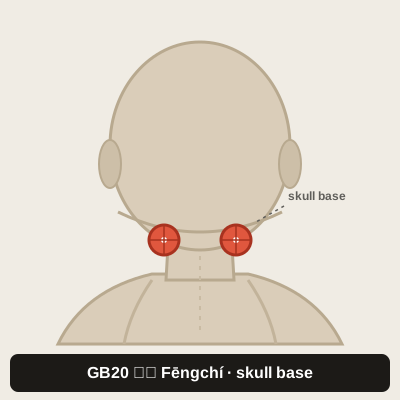
GB20 · Fēngchí
风池 · back of skull, neck hollows
Why people try it
A common point for neck and head tension.
How to use
Thumbs press up & in, 30–60s.
When to try
After screen time or when your neck feels tight.
How to tell you've got it
A spreading ache that can reach up the back of the head.
Common mistake
Pressing the skull instead of the hollow beneath it. Tilt your chin slightly down to open the space first.
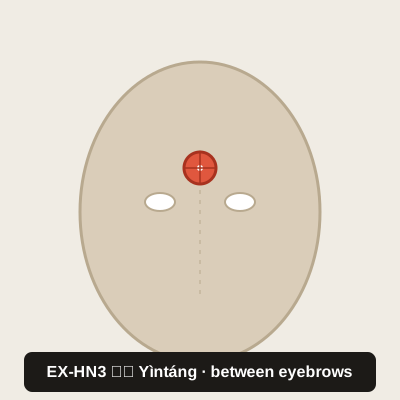
EX-HN3 · Yìntáng
印堂 · between the eyebrows
Why people try it
A simple point for a calmer, clearer feeling.
How to use
Thumb or index, slow circle, 30–60s.
When to try
When you want to slow down and breathe.
How to tell you've got it
A soft, releasing sensation across the brow — many people notice their jaw loosen first.
Common mistake
Drifting upward onto the forehead. Stay in the dip right between the inner ends of the brows.
The full routine
1LI4
both hands · firm circles · 30–60s
→
2Taiyang
both temples · small circles · 30s each
→
3GB20
base of skull · thumbs press up & in · 30–60s
→
4Yintang
between the brows · slow circles · 30–60s
Order matters more than force — hand first, then the temples, then the base of the skull. Stop between steps, breathe out slowly, and let your shoulders drop before moving on.
Common questions
Which acupressure point is used for headaches?
LI4 (the web between thumb and index finger) and Tàiyáng (the temple) are the two most commonly reached for in traditional practice. GB20 (the hollows at the base of the skull) and Yìntáng (between the eyebrows) are often added when the tension runs up the back of the head or sits across the brow.
How long should I press each point?
About 30–60 seconds per point, on both sides. Firm but comfortable — a dull ache, never sharp pain. Breathe out as you press.
Should I press during a headache or before one starts?
Both are reasonable in traditional practice. Many people press at the first sign of everyday head or face tension, and again during screen breaks. It is a traditional wellness practice, not a treatment — if headaches are severe, sudden, or getting worse, see a clinician.
Want all 15 points in one printable guide?
This page covers what you need for today. The Starter Kit puts the full set of 15 points together
with 6 ready-to-use routines — bedtime, travel, daily reset, morning, desk and monthly comfort — plus
9 hand-demo clips so you can see the press-and-hold motion, not just read about it.
- ✓ 15 points, each with a clear diagram
- ✓ 6 guided routines
- ✓ 9 hand-demo clips — included with your kit
- ✓ Yours forever + every future update
Get the Starter Kit — $12
See all 15 points first — free
Educational use only — not medical advice. Acupressure is a traditional practice, not a medical treatment.
This page describes how the points are traditionally used; results vary, and nothing here diagnoses, treats, or
cures any condition. Points marked as avoided in pregnancy (LI4, SP6, GB21) should be skipped if you are or may be
pregnant — check with a qualified practitioner first. Don't press on injured, inflamed, or broken skin.
For persistent, severe, or worsening symptoms, see a clinician.
← Back to PRESS HERE · All 15 points ·
Privacy · Terms